
Contents
Ohms Law Definition
Ohm’s law defines a linear relationship between the voltage and the current in an electrical circuit.
The DC current flow through a resistor is set by the resistor’s voltage drop and the resistor’s resistance.
With water flow analogy we can imagine the electric current as water current through pipe, the resistor as a thin pipe that limits the water flow, the voltage as height difference of the water that enables the water flow.
OHMS LAW CIRCUIT:
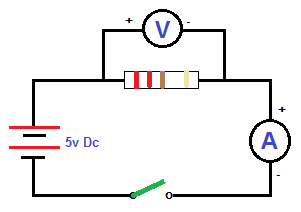
Ohm’s law
Ohm’s law definition :- The resistor’s current I in amps (A) is equal to the resistor’s voltage VR=V in volts (V) divided by the resistance R in ohms (Ω)
V is the voltage drop of the resistor, measured in Volts (V). Sometimes E is used instead of V . E denotes electromotive force. I is the electrical current fl0wing through the resistor, measured in Amperes (A) R is the resistance of the resistor, measured in Ohms (Ω)
Voltage calculation
When we know the current and resistance, we can calculate the voltage. The voltage V in volts (V) is equal to the to the current I in amps (A) times the resistance R in ohms (Ω):

Resistance calculation
When we know the voltage and the current, we can calculate the resistance. The resistance R in ohms (Ω) is equal to the voltage V in volts (V) divided by the current I in amps (A)
Since the current is set by the values of the voltage and resistance, the Ohm’s law formula can show that:

If we increase the voltage, the current will increase.
If we increase the resistance, the current will reduce.
Example =1 Find the current of an electrical circuit that has resistance of 50 Ohms and power supply of 5 Volts.

Solution:V = 5V
R = 220Ω
I = V / R = 5V / 220Ω = 0.02A = 22 mA.
Unit Name Unit Symbol Quantity.
| Unit Name |
Unit Symbol |
Quantity |
| Ampere (amp) | A | Electric current (I) |
| Volt | V | Voltage (V, E)Electromotive force (E)Electric potential (φ) |
| Ohm | Ω | Resistance (R)Impedance (Z) |
| Watt | W | Electric power (P) |
| Decibel-milliwatt | dBm | Electric power (P) |
| Decibel-Watt | dBW | Electric power (P) |
| Volt-Ampere-Reactive | VAR | Reactive power (Q) |
| Volt-Ampere | VA | Apparent power (S) |
| Farad | F | Capacitance (C) |
| Henry | H | Inductance (L) |
| siemens / mho | S | Conductance (G)Admittance (Y) |
| Coulomb | C | Electric charge (Q) |
| Ampere-hour | A·h | Electric charge (Q) |
| Joule | J | Energy (E) |
| Kilowatt-hour | kWh | Energy (E) |
| Electron-volt | eV | Energy (E) |
| Ohm-meter | Ω∙m | Resistivity (ρ) |
| siemens per meter | S/m | Conductivity (σ) |
| Volts per meter | V/m | Electric field (E) |
| Newtons per coulomb | N/C | Electric field (E) |
| Volt-meter | V·m | Electric flux (Φe) |
| Tesla | T | Magnetic field (B) |
| Gauss | G | Magnetic field (B) |
| Weber | Wb | Magnetic flux (Φm) |
| Hertz | Hz | Frequency (f) |
| Seconds | s | Time (t) |
| Meter / metre | m | Length (l) |
| Square-meter | m2 | Area (A) |
| Decibel | dB | |
|
Parts per million |
ppm |
Units prefix table
|
Prefix |
PrefixSymbol |
Prefix factor |
Example |
|
pico |
p |
10-12 |
1pF = 10-12F |
|
nano |
n |
10-9 |
1nF = 10-9F |
|
micro |
μ |
10-6 |
1μA = 10-6A |
|
milli |
m |
10-3 |
1mA = 10-3A |
|
kilo |
K |
10 3 |
1KΩ = 1000Ω |
|
mega |
M |
10 6 |
1MHz = 106Hz |
|
giga |
G |
10 9 |
1GHz = 109Hz |


