
What is Silicon?
Silicon (Si) is a chemical element with atomic number 14. It is an important semiconductor used in electronic devices.
Silicon Atom:
Protons: 14
Electrons: 14
Valence electrons: 4
Electron arrangement: 2, 8, 4
K Shell → 2 electrons
L Shell → 8 electrons
M Shell → 4 electrons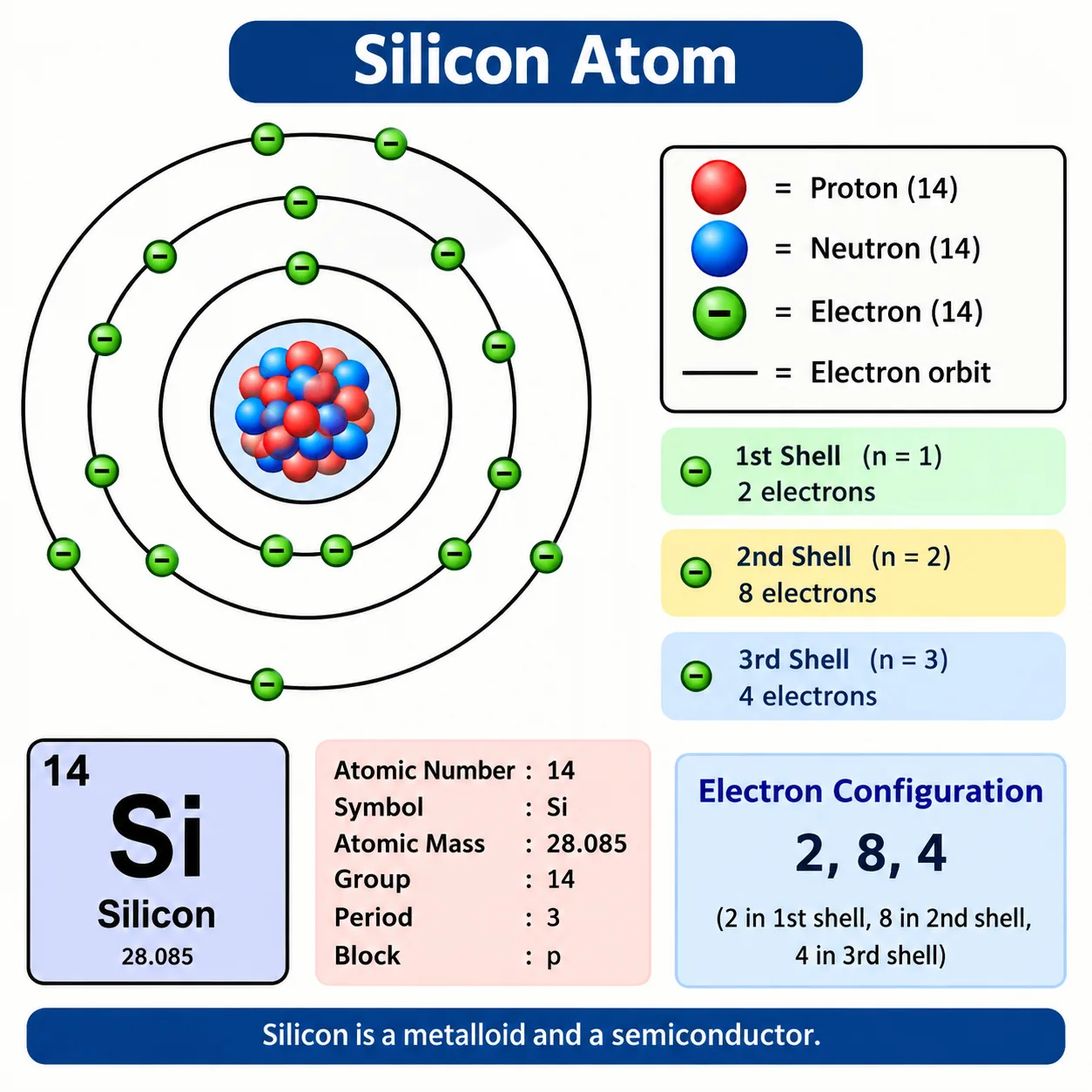
Why is Silicon Important?
Silicon has 4 valence electrons. These electrons allow silicon atoms to form strong covalent bonds and make silicon useful for controlling electrical current.
Uses of Silicon:
⚡ Electronics – Transistors and ICs
💻 Computers – Processors and memory chips
☀️ Solar Panels – Solar cells
📱 Mobile Devices – Semiconductor circuits
🔌 Diodes – Electronic switching and rectification
Silicon as a Semiconductor:
Silicon can conduct electricity better than an insulator but not as well as a metal.
Its electrical conductivity can be controlled by adding small amounts of impurities. This process is called doping.
Two Types:
N-Type: More free electrons
P-Type: More holes
Remember:
Silicon = Si = Atomic Number 14 = 4 Valence Electrons = Important Semiconductor
Silicon vs Silicone:
Silicon → Chemical element used in electronics.
Silicone → Synthetic polymer used in seals, insulation and other products.
Silicon is a natural chemical element with the symbol Si and atomic number 14 that is widely used as a semiconductor in computers and electronics. [1, 2]
Key Properties
1. Abundance: It is the second most common element in the Earth’s crust, right after oxygen.
2. Appearance: It is a hard, brittle solid with a shiny, blue-gray metal-like look.
3. Semiconductor: It conducts electricity better than an insulator, making it ideal for controlling electrical signals.
4. Occurrence: Pure silicon is never found by itself in nature; it usually combines with oxygen to form silica (sand and quartz).


